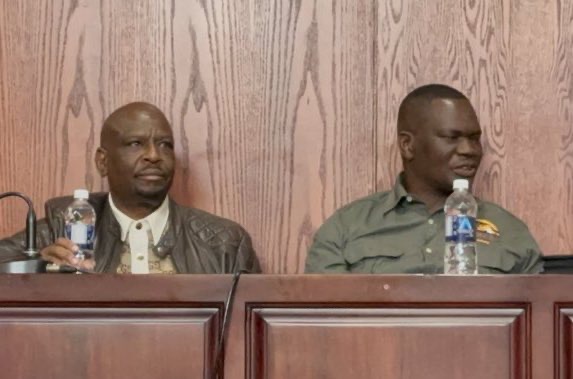
The prosecution is pushing for a 35-year prison sentence for businessmen Moses Mpofu and Mike Chimombe, who were recently convicted of fraud in connection with the Presidential Goat Scheme. Their sentencing is expected to be delivered on Monday.
Mpofu and Chimombe were found guilty of using falsified documents to win a tender to supply 632 001 goats under a Government livestock pass-on programme valued at US$87 757,16. Although the tender had initially been awarded to Blackdeck Private Limited, the contract was later signed by a different and unregistered entity, Blackdeck Livestock and Poultry Farming, with the Ministry of Lands, Agriculture, Water, Fisheries, and Rural Development.
Investigations later revealed irregularities in the company's compliance documents. It was established that the firm did not hold a valid 2021 tax clearance certificate, while a QR code on the NSSA certificate submitted in support of the tender was traced to a completely different business, Skywalk Investments.
Prosecutor Whisper Mabhaudi urged the court to impose a sentence exceeding the standard 20-year maximum, insisting that the level of deception used and the potential prejudice to the nation warranted a harsh penalty. He argued that the justice system needed to send a strong deterrent message.
"This offence shocks the conscience of man," Mabhaudi said. "The circumstances demand the maximum penalty under the law. The court must send a clear message to deter others and restore hope that those draining this nation's economy will face justice."
Defence lawyers, however, argued for leniency. Representing Mpofu, John Koto submitted that using fraudulent documents should not be equated with actual prejudice arising from contract execution. Professor Lovemore Madhuku, appearing for Chimombe, conceded that the offence was serious but insisted that his client played a minimal role and should not receive the same sentence as Mpofu.
Madhuku criticised the Ministry of Lands, Agriculture, Water, Fisheries, and Rural Development for failing to detect the fraud during evaluation, questioning how a committee led by legal professionals could have overlooked glaring inconsistencies.
"The negligence of State officials is glaring. How could a committee led by a lawyer fail to uncover the fraud? The entire ministry evaluated nothing. This failure must be addressed," said Madhuku, further noting that no official report detailing the financial prejudice suffered by the State had been produced.
Mabhaudi countered that the real victims of the fraud were not the institution itself, but vulnerable communities expected to benefit from the livestock project. These included widows, orphans, the elderly, persons with disabilities and the chronically ill, selected through a public service database.
Following the awarding of the tender, the ministry disbursed ZWL1,6 billion in two payments in 2022, then equivalent to US$7 712,197 — funds that prosecutors argue should have reached beneficiaries through goat distribution.
The court is set to deliver its final ruling when the two men return for sentencing.
- The Herald



 ZCTU implores govt to review US$150 minimum wage
  DRC bans US dollar cash payments
  Trump admin launches $166B tariff refund portal
  Gold-backed ETF set for VFEX debut
  Zimbabwe's currency is undervalued by nearly half
  Zimbabwe moves to crack down on proxy mining deals
  Young Investment Professional (YIP) Graduate Programme 2019
 Young Investment Professional (YIP) Graduate Programme 2019

Editor's Pick