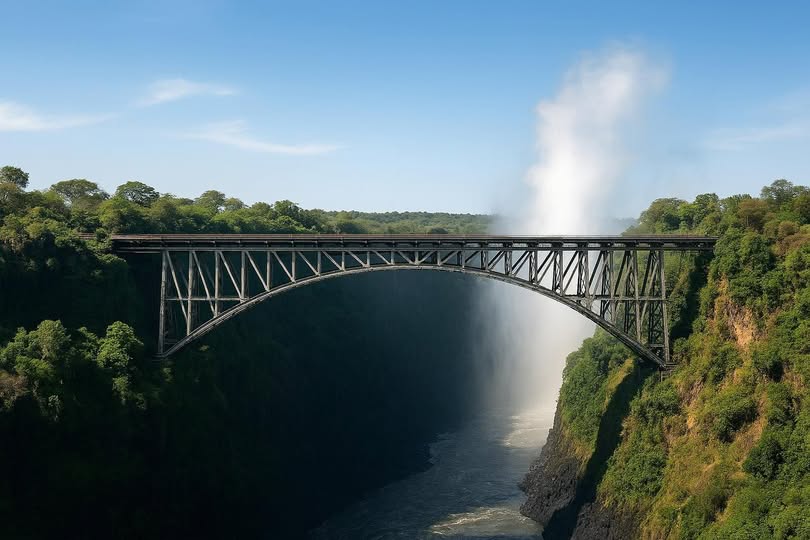
The governments of Zimbabwe and Zambia have agreed to restrict the use of the Victoria Falls Bridge by heavy trucks and trains, marking a decisive shift from years of debate over the future of the century-old structure toward a new infrastructure strategy centred on building a modern crossing.
Speaking at an engineering conference in Livingstone, Zambian President Hakainde Hichilema said the 121-year-old bridge was no longer suited to the demands of modern freight traffic, citing both its age and the mismatch between its original design and today's heavy-duty transport requirements. The announcement represents the clearest bilateral commitment yet to separate heritage preservation from commercial logistics along one of Southern Africa's key trade corridors.
Completed in 1905, the Victoria Falls Bridge was designed for early 20th-century rail and road loads, long before the emergence of high-volume regional freight systems. While periodic rehabilitation, including upgrades in 2006, extended its operational life, the structure has continued to operate under weight and speed restrictions, with trains crossing at extremely low speeds and heavy trucks subject to load limits. Those constraints have increasingly placed it at odds with the rapid growth in cross-border trade along the North-South Corridor.
The decision to limit heavy traffic reframes the long-standing policy question from whether the bridge can be upgraded to how best to replace its freight function. Engineers and policymakers have increasingly converged on the view that large-scale rehabilitation would be both technically invasive and economically inefficient, potentially costing as much as constructing a new crossing while still leaving fundamental capacity limitations unresolved.
Attention has now shifted to the development of a new road-and-rail bridge downstream of Victoria Falls, where the geography of the Batoka Gorge offers more suitable conditions for modern infrastructure. Such a crossing would allow for the design of a dual-purpose facility capable of handling high-capacity road freight and rail traffic, while preserving the existing bridge for tourism, light vehicles and pedestrian use.
The approach mirrors the model adopted at the Kazungula Bridge, which has significantly expanded regional freight capacity since its commissioning in 2021. Traffic volumes at Kazungula have risen sharply, underscoring both the scale of demand and the limitations of older infrastructure along competing routes.
For Zimbabwe, the proposed development carries significant implications for trade competitiveness. The Victoria Falls corridor links the country's interior and the Beitbridge border post with Zambia and the Democratic Republic of Congo, forming a critical segment of regional supply chains for minerals and agricultural commodities. Current restrictions at the bridge have effectively acted as a bottleneck, increasing transit times and costs relative to alternative crossings such as Kazungula and Chirundu.
For Zambia, the rail component of the proposed project is particularly strategic. The existing bridge is the only rail link between the two countries, and any restriction on freight rail without a replacement would disrupt connectivity between the Zambian network and Zimbabwe's rail system. A new crossing would not only preserve that link but could also support future regional rail integration, including planned extensions connecting Botswana and Zambia through Livingstone.
Despite the strong economic rationale, financing remains the central challenge. Large-scale infrastructure projects of this nature typically require multilateral support, but Zimbabwe's access to concessional funding is constrained by its external debt arrears. Zambia, having made progress on debt restructuring, is in a relatively stronger position to anchor financing arrangements, potentially with Zimbabwe participating under structured or deferred terms.
The timing of the announcement is therefore significant. Zimbabwe is currently implementing a Staff-Monitored Programme with the International Monetary Fund aimed at restoring fiscal discipline and rebuilding creditor confidence. Progress under that framework could improve the country's prospects of participating in jointly financed infrastructure projects, including a new Victoria Falls crossing.
If realised, the project would represent one of the most consequential transport investments in Southern Africa since Kazungula, with the potential to remove a longstanding bottleneck from the North-South Corridor and reshape regional logistics flows. For now, however, the agreement to restrict heavy traffic on the Victoria Falls Bridge signals the beginning of a transition—away from adapting a historic structure to modern demands, and toward building infrastructure designed for the realities of contemporary trade.
- online








 Zanu-PF sacrifices pro-Mnangagwa MPs
  Ramaphosa disowns 'shady' Chivayo
  Trump admin launches $166B tariff refund portal
  Zimbabwe to launch SME-focused exchange
  Zimbabwe defends high interest rates
  Air Zimbabwe misses London flight deadline
  Young Investment Professional (YIP) Graduate Programme 2019
 Young Investment Professional (YIP) Graduate Programme 2019

Editor's Pick